Getting Ready for Your IPO: Advice for Pre-IPO Companies

Along with providing an infusion of capital to a growing company, going public brings strict financial reporting and compliance requirements that must be in place well before the offering.

To meet investor expectations for a timely closing and regulatory requirements to provide accurate disclosures, pre-IPO companies need to have the right people, processes, and technology in place to meet their needs as a public company.

Evaluate Finance’s Pre-IPO Team to Ensure They Are Ready

An important early step is assessing the skills and capabilities of the organization’s finance team. Management needs to be sure the team can meet the complex reporting and compliance needs of a public company, such as developing adequate internal controls and preparing accurate financial reports on a timely basis.

Financial planning and analysis skills are also critical since investors expect accurate forecasts about key metrics such as the company’s revenue, business outlook, net income, and operating cash flow. Being able to develop and share accurate forecasts is valuable in informing investors and avoiding potential surprises.

Hone Reporting Processes

Perhaps the most obvious difference between public and private companies is the requirement to report financial and operating results quarterly. The finance team must close the books and report the company’s results quickly and accurately. It will need to develop and follow an efficient, repeatable process.

At least a year before the offering, it’s important to schedule quarterly rehearsals of the reporting process as if the company were public. Practice the multiple steps in closing the books, preparing an earnings release, and holding a mock investor call. This ensures the company’s finance team and management are familiar with the process when they must disclose actual earnings after the offering.

Know How and What You Will Show to Investors

Another important part of the reporting process is establishing metrics to help management explain the company’s results to investors. Along with determining the most appropriate metrics, management should be ready to explain why they chose a specific metric and why it’s helping in understanding the company’s performance.

Similarly, the company will need to establish and document its internal controls, as well as the reasons behind the controls they create.

Implement Financial Management Tools

Another critical step in preparing for an IPO is upgrading the company’s financial tools to support these new reporting requirements and regulatory disclosures. Spreadsheets, for example, that may have been sufficient in the early stages of the company won’t allow the finance team and management to develop reports quickly. This will likely require manual workarounds (such as copying data between applications and reformatting documents) that take time and can introduce errors and delay the close process.

It’s more effective and efficient to implement a scalable financial management solution such as Sage Intacct that enables companies to automate the reporting process and general ledger entries, and to help the finance team close the books and prepare quarterly reports more rapidly and accurately.

Effective financial management will also provide management with daily visibility into the company’s revenue and treasury activities, and will offer data analysis and reporting tools to speed the closing process, offer insights into the company’s performance and trends, and support more strategic decision-making.

Does Your Pre-IPO Company Have What It Takes to Go Public?

Overall, pre-IPO companies must act as if they are public before the initial public offering. Creating and honing the company’s processes and technology tools will help it be better able to operate as a public company and be ready and able to meet strict disclosure requirements and satisfy investor expectations.

For more information on preparing for IPO with Sage Intacct, reach out to our team for a consultation and demo.

3 Tips for Boosting the Value of Your SOX 404(a) Compliance

Beyond regulatory requirements, developing an effective internal controls framework is valuable in helping your company manage risk.

Identifying and mitigating the company’s financial and operational risks under the Sarbanes Oxley Act’s (SOX) Section 404 requirements can also be a prudent investment in improving efficiency by aligning management’s priorities with the organization’s internal processes and operations.

3 Tips for Getting the Most Out of SOX Compliance

1.      Understand Your Obligations (SOX 404a vs 404b)

One of the keys to successful SOX compliance is understanding whether your company falls under the reporting requirements of 404 Section (a) or Section (b). While management must certify the effectiveness of its internal controls in either case, Section (b) adds the requirement (based on the company’s capitalization and revenue) for your external auditor to attest to that effectiveness.

In practice, we often see companies that are not required to file under Section (b) scale back their compliance efforts by trimming assessments to the bare bones and eliminating internal testing — yet continuing to issue certifications.

This may seem like a cost-savings move, but the company may run into significant deficiencies and material weaknesses that are discovered during the year-end external audit. This, in turn, leads to additional remediation steps that must be implemented quickly. More importantly, these deficiencies can reduce confidence in the quality of the company’s financial reporting and internal controls from auditors, the board, and potentially investors.

Taking the time to develop an effective compliance framework and culture helps your company manage risk more effectively while also satisfying your regulatory obligations.

2.      Focused Attention

It’s critical for your company’s management to identify the most important risks to the quality and accuracy of your financial statements, and to focus attention and resources on the areas that represent the most important risk.

The COSO Enterprise Risk Management – Integrated Framework offers a good starting point for developing an effective internal controls system. The framework offers 17 principles embedded within five components outlining your controls environment, risk assessment, control activities, and other key aspects.

To learn more, you can view a recording of our webinar, Navigating SOX 404a Compliance.

Similarly, it’s helpful to understand that, over time, the company’s risk profile is going to evolve in response to market conditions as well as organizational changes. Part of an effective risk assessment strategy is understanding those changes, the potential impacts on the company, and the processes and controls that must be adjusted as a result.

3.      Build a Compliance Culture

Optimizing the value of your SOX investment, like your compliance effort, also depends on management setting an effective tone highlighting the importance of risk management and ethical behavior.

Management needs to stress the importance of compliance and risk management company-wide, and to back up those statements with internal training and quarterly check-ins to ensure management identifies and controls its most important financial statement risks.

Department leaders also need to understand that compliance isn’t a once-and-done or periodic activity, but rather an ongoing process of identifying risk, establishing effective controls, testing those controls, and making necessary corrections.

An effective compliance culture will improve risk management and cost savings by helping the company minimize last-minute surprises with its audit committee and auditors.

In addition, management can focus on the most direct risk to its financials, create appropriate controls, and produce the high-quality financial data the organization needs for external and internal reporting.

Getting Help With SOX 404a Compliance

Whether you’re looking to establish, enhance, or outsource your internal audit function, we provide ‘right-sized’ audit support to assist you. For more information about optimizing the value of your SOX investment, reach out to our team.

From Zero to SOX Implementation: Sarbanes-Oxley Compliance

The process of building a sustainable, comprehensive internal control environment sufficient to comply with the Sarbanes-Oxley act of 2002 (SOX) requires a significant investment of organizational resources. We have created the Zero to SOX implementation process to assist organizations in this endeavor.

A Five-Year Window for SOX Internal Control Audit Requirements

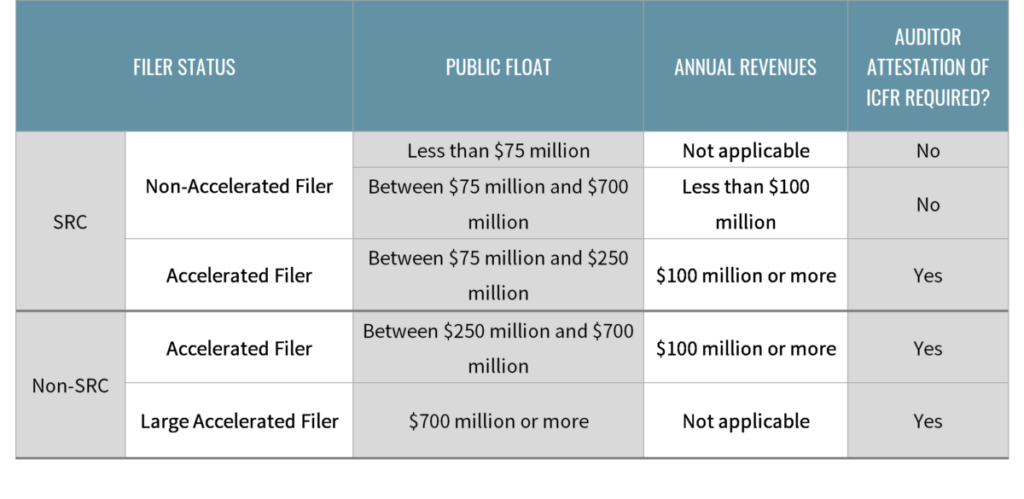
On March 12, 2020, the SEC issued a ruling – Amendments to the Accelerated Filer and Large Accelerated Filer Definitions.  The effect of the changes was to reduce the burden and compliance costs for certain smaller registrants.  Under the new rules, certain low-revenue registrants no longer are required to have their assessment of the effectiveness of internal control over financial reporting (ICFR) attested and reported on by their independent auditors. The figure below from the U.S. Securities and Exchange Commission shows a detail of thresholds between Small Reporting Companies (SRCs) and Non-SRC organizations.

While the burden may have been lifted for smaller organizations, the requirement of a comprehensive internal control environment remain. An emerging growth company’s annual report still must contain an internal control report which:

  • states management’s responsibility for establishing and maintaining an adequate internal control structure and procedures for financial reporting; and
  • contains an assessment, as of the end of the company’s most recent fiscal year, of the effectiveness of the company’s internal control structure and procedures for financial reporting.

During the five years following an IPO, a Small Reporting Company should take a risk-focused approach to SOX compliance by specifically identifying, implementing and monitoring those internal controls that enable management to achieve these regulatory requirements with confidence.

ZERO to SOX – A Five Year Timeline

Year One Pre-SOX

Activities in the first post-IPO year are focused upon the identification of HIGH Risk processes and the implementation of the documentation and monitoring activities necessary to support management’s annual reporting requirements under Section 404.

Years Two and Three Pre-SOX

Activities in the second and third post- IPO year are focused upon evaluating and understanding the company’s internal control priorities in light of the company’s growth and evolution.  Monitoring activities necessary to support management’s annual reporting requirements under Section 404 continue.

Year Four Pre-SOX

Activities in the fourth post-IPO year add the additional objective of documentation and assessment of the MODERATE and LOW risk processes.

Evaluating and understanding the company’s internal control priorities in light of the company’s growth and evolution continues along with monitoring activities necessary to support management’s annual reporting requirements under Section 404.

Year Five SOX

Activities in the fifth post-IPO year are focused upon the monitoring activities necessary to support management’s annual reporting requirements under Section 404 continue and those necessary to support the integrated audit work of the company’s external auditors.

Our SOX Services Helps Set Your Company Up for Long-term Compliancy

The Zero to SOX process designed with clearly defined goals, executed by experienced team members will lay the foundation to meet your company’s regulatory compliance requirements as well as practice effective corporate governance now and into the future.

For more information on our SOX Services, contact our team.

Are You at Risk? 7 Common SOX 404 Compliance Challenges to Avoid

Several SOX challenges can affect a company’s ability to maintain an effective controls framework, or potentially hinder its ability to demonstrate that its ICFR efforts serve their intended purpose.

Common SOX Challenges

1. A lack of executive or board support for the organization’s SOX program.

Management’s commitment to effective controls and financial reporting is a key component to a SOX effort receiving the required time and attention.

2. Failing to take a true risk-based approach.

It’s essential to understand the company’s risks and to design controls to mitigate those risks, rather than treating SOX as a check-the-box compliance exercise.

3. Over-engineering process documentation.

Concise documentation that helps staff members and external auditors understand the thinking underlying a process is more effective than trying to capture every potential contingency and nuance (which can divert attention from more important activities).

4. Confusing operational controls with financial reporting controls.

Along with ensuring the data is accurate, you need to verify that the process used to generate that data is operating effectively.

5. Infrequent and superficial coordination with external auditors.

Management and external auditors should understand the company’s risks to evaluate better the design and the effectiveness of the controls designed to mitigate those risks. Nobody should be surprised during the audit process.

6. Having control owners believe control ownership is separate from day-to-day activities.

This is typically a culture issue, but team members responsible for controls may not integrate risk and performance of controls as part of their typical activities.

7. Underutilizing IT and application automation and configurations.

Control activities performed manually, on a repetitive basis come with a greater cost and increased risk of error, when compared to automated controls.

Understanding the requirements of SOX 404(a) and 404(b) and communicating frequently with external auditors about the design and performance of your controls are cornerstones of effective risk management and SOX compliance. Knowing these SOX challenges can help a company with its compliance journey.

For questions or more information about SOX compliance, visit our SOX services page or contact our team.

Independent Assurance Inspires Confidence in Sustainability Reports During COVID-19

Sustainability reports explain the impact of an organization’s activities on the economy, environment, and society. During the novel coronavirus (COVID-19) pandemic, stakeholders continue to expect robust, transparent sustainability reporting, with a stronger emphasis on the social and economic impacts of the company’s current operations than on environmental matters.

Investors, lenders, and even the public at large may pressure companies to issue these supplemental reports. But the information they provide isn’t based on U.S. Generally Accepted Accounting Principles (GAAP). So, is it worth the time and effort? One way to make your company’s report more meaningful and reliable is to obtain an external audit of it.

What Is a Sustainability Report?

A sustainability report generally focuses on a company’s values and commitment to operating sustainably. It provides a mechanism for communicating sustainability goals and how the company plans to meet them. The report also guides management when evaluating corporate actions and their impact on the economy, environment, and society.

During the COVID-19 crisis, stakeholders want to know how your company handles issues such as public health and safety, supply chain disruptions, strategic resilience, and human resources. For example:

  • How is the company treating employees during the crisis?
  • Are workers being laid off or furloughed — or is management implementing executive pay cuts to retain its workforce?
  • What is the company doing to ensure its facilities are safe for workers and customers?
  • Is the company donating to charities and encouraging employees to participate in philanthropic activities during the crisis, such as volunteering at food pantries and donating blood?

Stakeholders want assurance that companies are engaged in responsible corporate governance in their COVID-19 responses. Sustainability reports can showcase good corporate citizenship during these challenging times.

Why Do You Need an External Audit?

There aren’t currently any mandatory attestation requirements for sustainability reporting. That means companies can produce reports without engaging an external auditor to review the document for its accuracy and integrity. However, without independent, external oversight, stakeholders may view sustainability reports with a significant degree of skepticism. That’s where audits come into play.

Many organizations have developed standardized sustainability frameworks, including the:

  • Carbon Disclosure Project (CDP),
  • Dow Jones Sustainability Index (DJSI),
  • Global Initiative for Sustainability Ratings (GISR),
  • Global Reporting Initiative (GRI),
  • International Integrated Reporting Council (IIRC),
  • Sustainability Accounting Standards Board (SASB), and
  • United Nations Sustainable Development Goals (SDG).

External auditors can verify whether sustainability reports meet the appropriate standards and, if not, adjust them accordingly. In addition, numerous attestation standards govern the audit of a sustainability report, including those from the American Institute of Certified Public Accountants, the International Standard on Assurance Engagements, and the International Organization for Standardization.

Need Help?

Many companies agree that a sustainability report is important to their communications with stakeholders. But there’s little consensus on the approach, topics, or non-GAAP metrics that should appear in sustainability reports. We understand the standards that apply to these supplemental reports and can help you report sustainability matters in a reliable, transparent manner. Contact us today to speak to one of our industry professionals.

The Most Common Lease Accounting Discount Rate Myths

Understanding and Avoiding Discount Rate Myths in Lease Accounting

As companies adopt ASC 842, selecting and estimating the discount rates embedded within their various leases will play an important role in their implementation as well as their accounting going forward.

These decisions can be complicated by common misunderstandings about the different types of discount rates available, as well as the potential implications to the organization’s balance sheet.

The Discount Rate Options for Lessees Include:

  • Implicit Rate (IR): The interest rate on a given date that generates the aggregate present value of the lease payments, and the amount a lessor expects to derive from the underlying asset following the end of the lease term.
  • Incremental Borrowing Rate (IBR): The interest rate a lessee would have to pay to borrow, on a collateralized basis, an amount equal to the lease payments over a similar term and in a comparable economic environment.
  • Risk-Free Rate (RFR): The rate of a zero-coupon U.S. Treasury instrument using a period comparable with the lease term.

Myths and Misunderstandings Associated with Each Election

Common Implicit Rate Myth:

  • Myth: The implicit rate on financing leases (formerly known as capital leases) will be easy to obtain, whether stated explicitly in the lease agreement or readily available from the lessor.
  • Fact: It’s unlikely the lessor will be willing to share the implicit rate, since the data underlying the rate is related to the lessor’s profit on the agreement. The lessee will need to calculate the implicit rate based on information including the fair market value of the leased asset, the estimated residual value of the underlying asset at the end of the lease, and any initial direct costs deferred by the lessor.

Common Incremental Borrowing Rate Myths

  • Myth: The IBR is the interest rate on an easily accessible line of credit.
  • Fact: This approach was allowable under ASC 840, but lessees must use a collateralized rate under ASC842.
  • Myth: The IBR is the weighted average interest rate that a lessee pays on its other debt.
  • Fact: Lease terms and other economic characteristics will vary, precluding the use of a blended rate.
  • Myth: A lessee can use the same IBR for all of its leases.
  • Fact: ASC 842 requires applying discount rates to each individual lease, therefore IBR needs to be determined for each lease. A lessee may elect the “portfolio approach” practical expedient and apply the calculated IBR across a similar group of assets such as a vehicle fleet.

Common Risk-Free Rate Myth:

  • Myth: Lessees can elect to use the risk-free rate on certain leased assets, and the incremental borrowing rate and/or the implicit rate on other leases as they see fit.
  • Fact: If a lessee elects to adopt the risk-free rate practical expedient under ASC 842, they must apply the risk-free rate to all leased assets —even if a lease was classified previously as a capital lease with a known implicit rate.

Note: The FASB released a proposed update in September 2021 allowing a lessee that is not a public entity to make the risk-free rate accounting policy election by class of underlying asset, rather than for all assets under lease. Under this proposal, a lessee will be required to use the implicit rate when it is readily determinable (instead of the risk-free rate), regardless of whether the lessee applies the risk-free rate election.

Questions? Contact us to discuss the best approach to determining an appropriate discount rate for your leases, or for other ASC 842 implementation questions.

How to Calculate a Discount Rate for Lease Accounting

One of the many determinations companies need to make as they implement ASC 842, the new lease accounting standard, is calculating the appropriate discount rate for their leases.

For lessees, selecting and estimating the discount rate will have an impact on the lease liability and right of use asset (ROU) on the organization’s balance sheet. There are several options, each with potentially different outcomes, so making the most appropriate choice for your organization is a critical step in the process. Generally speaking, a lower discount rate results in a larger liability as there is less of an interest component to the calculation.

Lessees’ Discount Rate Options Include:

Implicit Rate (IR)

This is defined as the interest rate on a given date that generates the aggregate present value of the lease payments, and the amount a lessor expects to derive from the underlying asset following the end of the lease term.

To determine the implicit rate, the lessee needs to know some of the assumptions used by the lessor in pricing the lease. This includes the underlying fair market value of the asset under lease, the estimated residual value of the underlying assets at the end of the lease, and any direct costs that may have been deferred by the lessor. In many cases, this choice may be impractical because much of the information needed to calculate the implicit rate is not readily available to the lessee.

Incremental Borrowing Rate (IBR)

This is defined as the interest rate a lessee would have to pay to borrow, on a collateralized basis, an amount equal to the lease payments over a similar term and in a comparable economic environment. Among the ways to calculate an IBR are using your rate on existing debt or recent loan; the borrowing rate of similar entities with comparable credit risk; or an interest rate quoted by your lender if you were to borrow funds to purchase a similar asset.

Risk-Free Rate (RFR)

The RFR is the rate of a zero-coupon U.S. Treasury instrument using a period comparable with the lease term. This provides a practical expedient alternative for private companies.

New Discount Rate Options

Making this decision became a little bit easier in mid-September as the Financial Accounting Standards Board (FASB) gave private companies and nonprofit organizations flexibility in choosing the discount rate used in calculating the value of their operating leases.

Under FASB’s revised guidance, an entity can choose between a discount rate such as an IBR and a risk-free rate for its leased assets.

The FASB also gave entities the option of selecting different discount rates for various classes of leases, instead of applying the same discount rate to all operating leases. This gives organizations the flexibility of calculating an IBR for high-value leases, such as real estate, and applying an easy-to-determine risk-free rate for low-value leases such as office equipment.

Discount Rate Disclosures

Lessees are required to disclose information about any significant assumptions or judgments to apply ASC 842, and this may include how they determined the discount rate for their leases. In addition, if a lessee elects the accounting policy to use the RFR, they should disclose this policy, assuming it is considered to be a significant accounting policy.

To learn more about choosing a discount rate or other aspects of your lease accounting implementation, reach out to our experts for help.

6 Steps Private Companies Should Take to Prepare for ASC 842 Lease Accounting

Get Prepared for ASC 842 Lease Accounting Standard

Private companies and nonprofits will soon be subject to the ASC 842 lease accounting standard. Adopting this standard is effective for annual reporting periods ending after December 15, 2021. For calendar year-end companies, the effective date is January 1, 2022. For companies with a fiscal year-end, the effective date would be the first interim period after their fiscal year-end (i.e., the effective date for a fiscal year-end of June 30, 2022, would be July 1, 2022).

Our Six Helpful Steps to Prepare Your Company for ASC 842 Compliance

1. Review Your General Ledger Accounts.

Review your general ledger accounts, looking specifically for fixed recurring and variable payments for existing leases and other contracts, which may have embedded leases under the new standard. Embedded leases are determined by the lessee’s use and control over any identified assets in the agreement. The most common embedded lease is typically within an IT service contract if it specifies underlying hardware that may be included.

2. Inventory your Contracts and Review Key Terms and Payments.

Create an inventory of your contracts and review key information in those contracts, including fixed payments, indexed payments, renewal options, residual guarantees, initial direct costs, lease incentives, and options to purchase. In addition, payments to the lessor may include fixed non-lease payments such as insurance, maintenance, and taxes. There is a policy election that allows these costs to be included should a company desire to do so.

3. Separate Fixed and Variable Payments.

Fixed lease payments are those recurring payments that are the same amount each month, including payments with a fixed percentage increase based on specified dates or anniversaries. In contrast, a payment based on an unknown future rate, such as the CPI index or lessee’s sales, are considered variable. These are treated differently under the new standard.

4. Consider Policy Elections and the Election of Practical Expedients.

Policy Election Options:

  • Combine fixed lease and non-lease payments
  • Use the interest-free rate to avoid determining the discounted rate
  • Exclude leases with payments of twelve months or less
  • Apply the same discount rate to a class of assets or assets with a similar lease term

 Practical Expedients Options:

  • Must elect as a group
  • Not to reassess expired or existing contracts that contain leases under ASC 842
  • Not to reassess operating and capital leases under ASC 840 that will be operating and financing leases under ASC 842
  • Not reassessing initial direct costs for existing leases

Separate Election

  • May elect to use hindsight to reassess leases for determining the lease term, purchase options, and termination payment

5. Evaluate Contracts to Determine Financing Lease Vs. Operating Lease classification

Financing Lease

  • Transfers ownership to the lessee
  • The purchase option is reasonably sure to be exercised*
  • The lease term is the major part of the economic life of the asset
  • The present value of the lease payments and residual value is substantially all the asset fair value
  • The asset is specialized in nature for the lessee and has no alternative use

* Example is a 60-month equipment lease with monthly payments of $500 with an option to purchase of $100, which the lessee intends to exercise.

Operating Lease

  • Ownership stays with the lessor
  • There is no option to purchase the asset
  • The lease term is not a major part of the asset’s economic life*
  • The value of the lease payments does not equal or exceed the fair value of the underlying asset
  • The asset is not so specialized to only have use for the lessee

* For example, an office lease with 60 monthly payments of $4,000 (for a total of $240k) would not be considered a major portion of a $2m building’s economic life of 30 years.

6. Evaluate Financial Statement Adoption Options.

  • Effective Date Method – The comparative reporting period is unchanged, and any cumulative effect is applied at the beginning of the adoption period. This eliminates the need to restate the prior period presented
  • Comparative Method – The earliest period presented is restated at the beginning of the period

For more information or help with your ASC 842 adoption requirements, don’t hesitate to contact us.

Auditing Work in Progress

Many types of businesses — such as homebuilders and manufacturers — turn raw materials into finished products for customers. Production is a continuous process. So, any work that’s been started but isn’t yet completed before the end of the accounting period is reported as work in progress (WIP) under U.S. Generally Accepted Accounting Principles (GAAP).

The value of WIP relies on management’s estimates. Auditors often give special attention to these estimates during fieldwork. Here’s what to expect during a financial statement audit.

Inventory 101

Inventory is classified as a current asset on the balance sheet under GAAP. There are three types of inventory:

  1. Raw materials. These are tangible inputs received from suppliers but haven’t yet been worked with. For example, a construction firm may have a supply of lumber and drywall in a warehouse that counts as raw materials.
  2. Work in progress. This term refers to partially finished products at various stages of completion. Items classified as WIP still require further work, processing, assembly, and/or inspection. It includes raw materials, labor, and overhead allocations.
  3. Finished goods. These items are fully complete. They may be ready for customers to purchase or, in the case of custom products, available for delivery or title transfer to customers.

Accounting For Costs: Standard vs. Job Costing

When a company produces large volumes of the same product, management allocates costs as each phase of the production process is completed. This is known as standard costing. For example, if a production process involves eight steps, the company might allocate 50% of its costs to the product once the fourth stage is completed.

On the other hand, when a company produces unique products — such as the construction of a factory or made-to-order parts — a job costing system is typically used to allocate materials, labor, and overhead costs as incurred.

Most experienced managers use realistic estimates, but inexperienced or dishonest managers may inflate WIP values. This can make a company appear healthier than it really is by overstating the value of inventory at the end of the period and understating cost of goods sold during the current accounting period.

Eye on WIP

Auditors focus significant effort on analyzing how companies quantify and allocate their costs. Under standard costing, companies typically record inventory (including WIP) at cost, and then recognize revenue once they sell finished goods. The WIP balance grows based on the number of steps completed in the production process. Auditors analyze the methods used to quantify a product’s standard costs, as well as how the company allocates the costs corresponding to each phase of production.

Conversely, with job costing, revenue recognition happens based on the percentage-of-completion or completed-contract method. Auditors analyze the process to allocate materials, labor, and overhead to each job. In particular, they test to ensure that costs assigned to a particular product or project correspond to that job.

Get Work in Progress Right

Under both methods, accounting for WIP affects the balance sheet and the income statement. We can help determine whether your company’s WIP estimates are reasonable and whether your accounting practices comply with the recent changes to the revenue recognition rules for long-term contracts, if applicable. Contact us for more information on auditing work in progress.

Wayfair: Sales Tax & State Income Tax Implications

The U.S. Supreme Court decision in South Dakota v. Wayfair created enormous changes for businesses making remote sales into the states related to sales tax. However, it may have had a grander impact than you realized. Could Wayfair have also impacted how you manage your state income tax obligations?

Sales Tax Perspective

To be required to collect and remit sales tax, a taxpayer must first have nexus, the connection that a business has with a state or other tax jurisdiction. Sales tax nexus can be physical or economic – or both.

The U.S. Supreme Court ruling in the 1967 sales tax case between National Bellas Hess and Illinois first established the physical presence rule. Quill v. North Dakota in 1992 was an attempt by that state to rewrite Bellas Hess and have sales tax nexus determined by additional standards. The state’s argument was overruled by the U.S. Supreme Court, continuing the physical presence standard established by Bellas Hess. Yet, “substantial nexus” has never been strictly defined for sales or state income taxes.

What is Substantial Nexus?

It’s generally accepted that “physical presence” can create a “substantial nexus,” such as having an office or employees in the taxing jurisdiction. Still, it can also refer to exhibiting at trade shows, making sales visits, or utilizing third-party contractors in the state. Maintaining inventory in a state can also create a physical presence – sometimes a surprise for companies that leverage Amazon’s FBA program or similar marketplace facilitators that store a company’s inventory in their warehouses in various locations.

What is Economic Nexus?

Economic nexus means a business has a certain number or volume (or sometimes both) of sales in a state over a set period. Economic nexus quickly became a widely accepted standard for determining “substantial nexus” for sales tax purposes by the states after the landmark 2018 South Dakota v. Wayfair, Inc. decision. The U.S. Supreme Court ruled in favor of South Dakota, which redefined what it means to have sales tax nexus.

The U.S. Supreme Court decided that sales tax “substantial nexus” does not require physical presence. As a result, out-of-state taxpayers could now be required to collect and remit sales tax due to only having an economic connection with the state.

Sales Tax Implications of Wayfair

Of the 45 states that impose a sales tax, all but two have now enacted an economic nexus standard (those two, Missouri and Florida, may enact their own economic nexus rules soon). Those 43 states and the District of Columbia each set their own rules, which generally kick in after $100,000 of sales or 200 transactions into a state in a year. However, it is best to verify the economic rules within each jurisdiction as they can vary significantly for some states.

Rather than simplify sales tax nexus determination, Wayfair added complexity. This can get especially confusing with the more than 10,000 overlapping sales and use tax jurisdictions in the country, each with the ability to enact its definition of economic nexus.

Furthermore, just because you have a sales tax nexus doesn’t necessarily mean you owe sales tax, as not all types of revenue are subject to a jurisdiction’s sales tax rules (most commonly, services are non-taxable). Ultimately, it is critical to be aware of your company’s physical presence nexus-creating activities, such as resident employees or employees crossing a state border to visit a customer. Your company’s economic nexus-creating activities, such as volume of sales or number of transactions, are to be able to evaluate where nexus is being created in any given year.

Business Activity Tax Perspective

In terms of what it means to have “substantial nexus” in a taxing jurisdiction for state business activity taxes, which includes most commonly income taxes and gross receipt taxes, it tends to follow the lead of sales tax, as there has not been a U.S. Supreme Court case addressing what it means to have “substantial nexus” for state income tax purposes, nor any other business entity level tax.

Initially, most taxpayers looked to Quill as a guide for state business activity tax purposes, as the Court in the Quill decision, found that the Commerce Clause under the U.S. Constitution requires a physical presence to have “substantial nexus” with the taxing jurisdiction for sales tax purposes. In response, most taxpayers concluded that until they had a physical presence in the state, they did not have “substantial nexus” and, therefore, were not subject to a state’s business tax.

Over time, as the economy changed, states started looking for ways to shift the state business tax burden from in-state to out-of-state taxpayers. One of the easiest ways to do so was to enact economic nexus standards for state business tax purposes. The most notable of these early adopters of economic nexus was Washington in 2010 and California in 2011.

Historically, California and Washington are the most aggressive states regarding state business taxes. As such, it was ultimately up to taxpayers to challenge the constitutionality of these state’s “right” to assert business tax nexus on an out-of-state taxpayer with no physical presence in the state.

Ultimately, by the time Wayfair made it to the U.S. Supreme Court in 2018, no taxpayer challenges of Washington or California’s business tax economic nexus thresholds, $267,000 and $500,000 in sales, respectively, had been accepted by the U.S. Supreme Court. As such, there remained uncertainty for business taxpayers, and many hoped that Wayfair would also provide the much-needed clarity of what it means to have “substantial nexus” for business tax nexus.

Business Activity Tax Implications of Wayfair

Instead, the Wayfair decision had consequences to business taxes that were entirely unexpected. In the Wayfair decision, the Court concluded that Quill’s physical presence standard for “substantial nexus” had never been a correct conclusion. Thus, any reliance on Quill’s physical presence test was retroactively voided. This opened a big door.

For example, Washington’s economic nexus threshold for their gross receipts tax was retroactively rendered constitutional by Wayfair. Now, the state could pursue certain non-compliant taxpayers for tax liabilities going back to 2010 instead of being limited to 2018 and forward without much risk of being overturned by the U.S. Supreme Court.

However, unlike sales tax, not all states have enacted economic nexus thresholds for business activity taxes. Even the states that have enacted a threshold, the amount of sales required to have business activity tax economic nexus ranges from $4,000,000 to $100,000, with the most common being $500,000 in sales.

Where We Are Today

Much needs to be answered regarding state income tax nexus. For instance, should state income tax nexus thresholds match those for sales tax – say, $100,000? From a state income tax perspective, $100,000 doesn’t necessarily make sense as the figure reflects not sales but state net taxable income. Should the threshold be higher or lower? Does the state have a bright-line test instead of a vague “doing business” standard in the state? (Can the threshold, for state income tax purposes, be less than $100,000 in sales? Unlikely.)

You have to look at many facts and circumstances in each potential income tax case – and at how aggressive a state may be regarding its income tax.

As with sales tax obligations, the pandemic created implications for state income tax nexus. Some states have temporarily suspended physical nexus regarding employees’ work locations. This is applicable only if the employee’s location is truly temporary, and it’s recommended that both the employee and the company agree on the employee’s location.

What to do? Your first best option if you find you have nexus exposure or think you might have it: Let your tax preparer know ASAP. As with sales tax, states can offer Voluntary Disclosure Agreements to help alleviate the penalties of non-compliance and limited lookback periods. Many states also offer amnesty periods free of interest and penalties for back-owed taxes.

And remember: Just because your company has nexus for sales tax doesn’t necessarily mean you have nexus for income tax or other taxes. Check with the state or a tax expert first.

Need Help With Making Sure You Are Compliant With Tax Rules?

By utilizing state and local tax experts to handle sales and income tax complexities, you can ensure you don’t make a costly misstep. Contact us to learn more about the services at Sensiba and how we can help your business maintain compliance.


“Let’s Put Our Differences Aside” The Importance of Empathy and Combatting Bias

Imagine you’re driving on the freeway. You’re maintaining the speed limit, abiding by all traffic laws, going about your typical morning commute. A flashy red sports car suddenly appears in your rearview mirror, tailgating inches from your bumper. After several seconds the car swerves to the other lane and immediately proceeds to bolt in front of your vehicle to cut you off before speeding away out of sight.

A primitive response to this situation would be anger, annoyance, and swift judgment. The abrupt behavior and type of vehicle may lead you to think to yourself, “Of course the egocentric, jerk doesn’t care about anyone else on the road.”

The act of stereotyping the driver off limited material information builds an instant emotional and psychological barrier that favors anger and judgment over curiosity and empathy. Perhaps the red sports car driver received the news that their mother is sick, maybe their wife is in labor, or maybe their child needs immediate attention. Knowing this information at the time of the incident would have likely led you to more patience, understanding, and acceptance of their behavior. Losing sight of what connects us as human beings makes it painfully easy to revert to harsh judgment rather than compassion, and this tendency is becoming increasingly consequential in our daily lives.

There is no denying that humans are genetically programmed to make snap judgments to trigger natural fight or flight instincts. Research from the University of York found that humans can form first impressions in a little as 33 to 100 milliseconds. While our predisposition to determine friend vs. foe remains critical in life-or-death scenarios, the tendency to instantly judge a person’s character based on a millisecond impression is an unfortunate side effect that humans must overcome to adequately address diversity and inclusion efforts. Whether that impression is formed by race, gender, political affiliation, or even hobby, the idea of creating “in” vs. “out” groups is something that psychologists have seen in children as young as 17 months old.

In the business world, unconscious biases can shape every facet of an organization. From hiring tendencies, promotion patterns, and even payment structures, unchecked biases can lead to unintentionally homogenous workforces that ultimately stifle innovation and originality. Teams with similar backgrounds and lifestyles inherently breed uniformity — a quality scantily preferred by businesses hoping to adapt and flourish in the long run. As Larry Dixon once said, “If two people were exactly alike, one of them would be unnecessary.”

Corporate diversity and inclusion efforts have become a hot ticket for combatting homogeny in the workplace. Businesses often pursue diversity in a clinical rather than personal way — focusing primarily on reaching racial and gender quotas to validate their progress opposed to embracing unique, independent thinkers. However, diversity efforts cannot solely focus on ticking off boxes and meeting quota goals. Rather, it must seek to provide an environment where unique points of view produce different questions, unlikely ideas, and productive problem-solving. This means setting aside initial biases and delving deeper into the reasons behind certain ideas and behaviors.

Inclusive discussions require respect, empathy, and a feeling of safety in vulnerable and potentially judgmental situations. To borrow an example from Tonie Snell, even if a company’s board is 20% women and 15% of their leadership is Latinx, those statistics are only substantial if every person feels comfortable enough to contribute their thoughts.

It takes a certain level of personal awareness to seek and understand others’ personal opinions and input successfully. It comes down to treating people like human beings rather than a running list of superficial attributes. How we ask for and respond to different opinions will determine how likely people will continue to be vulnerable and share their ideas.

In her TEDTalk, “Is it Enough to be Politically Correct,” Sally Kohn says that society’s need for political correctness has developed two common behaviors: filtered and insincere conversations or silence due to fear of offending others. Kohn says that rather than seeking political correctness, “what matters more is emotional correctness — the tone, the feeling, how we say what we say, the respect and compassion we show one another.” Approaching situations (particularly in cases of opposition or friction) with grace and empathy can tear down the emotional barriers that lead us to judge those that are initially perceived to be in our outgroup.

When it comes down to it, diversity is ever-evolving, and we must continuously strive to improve it. We must learn to question our initial judgments and lead conversations with open, inquisitive, and genuine intentions. No one is without fault, no one is without bias, and no one is above improvement. When we learn to overcome the “us vs. them” mentality, we begin to open the door to more meaningful relationships with our community.

To quote one of my personal heroes, Mr. Rogers, “As human beings, our job in life is to help people realize how rare and valuable each one of us really is, that each of us has something no one else has — or ever will have — something inside that is unique to all time. It’s our job to encourage each other to discover that uniqueness and to provide ways of developing its expression.”

Accounting for Property, Plant and Equipment (PPE) Assets

Businesses and not-for-profit entities capitalize on machines, furniture, buildings, and other property, plant and equipment (PPE) assets on their balance sheets. Here’s a refresher on some common questions about how to properly report these long-lived assets under U.S. Generally Accepted Accounting Principles (GAAP).

What’s included in book value?

PPE is reported on the balance sheet at historical cost. This includes the amount of cash or cash equivalents paid for an asset. Historical costs also may include costs to relocate the asset and bring it to working condition. Examples of capitalized costs include the initial purchase price, sales tax, shipping and installation costs.

Costs incurred during an asset’s construction or acquisition that can be directly traced to preparing the asset for service also should be capitalized. In addition, costs incurred to replace PPE or enhance its productivity must be capitalized. However, repairs and maintenance costs may be expensed as incurred.

GAAP doesn’t prescribe a dollar threshold for when to capitalize an asset. But, for simplicity, management may set a capitalization threshold as long as it doesn’t materially affect the financial statements. PPE below that threshold may be written off as incurred.

How long is the useful life?

Useful life is the period over which the asset is expected to contribute directly or indirectly to future cash flow. When estimating the useful life of an asset, management should consider all relevant facts and circumstances, such as:

  • The asset’s expected use,
  • Any legal or contractual time constraints,
  • The entity’s historical experience with similar assets, and
  • Obsolescence or other economic factors.

What’s the right depreciation method?

Depreciation is meant to allocate the cost of an asset (less any salvage value) over the period it’s in use. GAAP provides the following four depreciation methods:

  1. Straight-line,
  2. Sum-of-the-years-digits,
  3. Units-of-production, and
  4. Declining-balance.

For simplicity, many small businesses deviate from GAAP by using the same depreciation method for tax and financial statement purposes. The IRS prescribes specific recovery periods for different categories of PPE and provides accelerated depreciation methods.

Under current tax law, instead of using the standard Modified Accelerated Cost Recovery System (MACRS) depreciation method, certain entities currently may choose to immediately deduct a qualified PPE purchase under Section 179 or the bonus depreciation program, thus minimizing taxable income in the years the asset is placed in service. The use of these accelerated depreciation methods may create a large spread between the value of PPE on the balance sheets and the assets’ fair market values.

For more information on Property, Plant and Equipment Assets

Reporting PPE is a gray area in financial reporting that relies on subjective estimates and judgment calls by management. We can help you report these assets in a reliable, cost-effective manner. Contact us for more information on Property, Plant and Equipment reporting.

Best Practices for Cash Flow Forecasts

Cash flow is a top concern for most businesses today. Cash flow forecasts can help you predict potential shortfalls and proactively address working capital gaps. They can also help avoid late payments, identify late-paying customers, and find alternative funding sources when cash is tight.

Best Practices for Conducting Cash Flow Forecasts

Consider applying these four best practices to keep your company’s cash flow positive.

Identify Peak Needs

Many businesses are cyclical, and their cash flow needs may vary by month or season. Trouble can arise when an annual budget doesn’t reflect, for example, three months of peak production in the summer to fill holiday orders, followed by a return to normal production in the fall.

For seasonal operations — such as homebuilders, farms, landscaping companies, recreational facilities, and many nonprofits — using a one-size-fits-all approach can throw budgets off, sometimes dramatically. It’s critical to identify peak sales and production times, forecast your cash flow needs, and plan accordingly.

Account for Everything

Effective cash flow management requires anticipating and capturing every expense and incoming payment, as well as — to the greatest extent possible — the exact timing of each payable and receivable. However, pinpointing the exact costs and expenditures for every day of the week can be challenging.

Companies can face additional costs, overruns, and payment delays. Although inventorying all possible expenses can be tedious and time-consuming, it can help avoid problems.

Seek Sources of Contingency Funding

As your business expands or contracts, a dedicated line of credit with a bank can help meet your cash flow needs, including any periodic cash shortages. Interest rates on these credit lines can be comparatively high compared to other types of loans. So, lines of credit typically cover only short-term operational costs, such as payroll and supplies. They also may require significant collateral and personal guarantees from the company’s owners.

Identify Potential Obstacles

For most companies, the biggest cash flow obstacle is slow customer collections. Your business should invoice customers promptly and offer easy, convenient ways for customers to pay (such as online bill pay). For new customers, it’s important to perform a thorough credit check to avoid delayed payments and write-offs.

Another common obstacle is poor resource management. Redundant machinery, misguided investments, and oversized offices are just a few examples of poorly managed expenses and overhead that can negatively affect cash flow.

Adjusting as you Grow and Adapt

Your company’s cash flow needs today likely aren’t what they were three years ago — or even six months ago. And they’ll probably change as you adjust to the new normal. That’s why it’s important to make cash flow forecasts an integral part of your overall business planning. Contact us for more information.

Accounting for Cloud Computing Arrangements

The costs to set up cloud computing services can be significant, and many companies would prefer not to expense these setup costs immediately. Updated guidance on accounting for cloud computing costs aims to reduce differences in the accounting treatment for these arrangements. In a nutshell, the changes will spread more of the costs of implementing a cloud computing contract over the contract’s life than under existing guidance.

Old rules

Accounting Standards Update (ASU) No. 2015-05, Intangibles — Goodwill and Other — Internal-Use Software (Subtopic 350-40): Customer’s Accounting for Fees Paid in a Cloud Computing Arrangement, differentiated between agreements involving a software license and those involving a hosted service. However, it didn’t discuss how to record the associated implementation costs, which led to differences in the accounting treatment.

Under ASU 2015-05, when a cloud computing arrangement doesn’t include a software license, the arrangement must be accounted for as a service contract. This means businesses must expense the costs as incurred.

On the other hand, when an arrangement does include such a license, the customer must account for the software license by recognizing an intangible asset. To the extent that the payments attributable to the software license are made over time, a liability is also recognized.

New rules

ASU 2018-15, Intangibles — Goodwill and Other — Internal-Use Software (Subtopic 350-40): Customer’s Accounting for Implementation Costs Incurred in a Cloud Computing Arrangement That Is a Service Contract, instructs companies to apply the same approach to the capitalization of implementation costs associated with the adoption of a cloud computing agreement and an on-premises software license.

When companies implement ASU 2018-15, they can capitalize and amortize certain costs associated with the application development phase throughout the hosting arrangement. However, companies should expense costs incurred during the preliminary project and post-implementation phases.

Implementation guidance

Implementing the updated guidance will require the following steps:

Identify cloud computing arrangements

Each line of business, as well as the supply chain management and payables departments, should be instructed to notify the accounting department of any new cloud computing agreements.

Decide whether to capitalize or expense implementation costs

ASU 2018-15 requires that companies follow the guidance in Subtopic 350-40 to determine which implementation costs to capitalize as an asset and which to expense.

Forecast the financial implications

For each contract, model the impact on your company’s financial statements. Because the standard allows for the deferral of implementation costs vs. expensing the costs as incurred, there will be a corresponding impact on your company’s financial ratios.

Need help?

Public companies must start implementing to ensure compliance for annual reporting periods beginning on or after December 15, 2019. Private companies and nonprofits have an extra year to comply — or they may adopt the changes early to spread more set-up costs throughout their contracts. If you’re unsure how to account for cloud computing arrangements, contact us.

Benchmarking: Why Normalizing Adjustments Are Essential

Financial statements aren’t particularly meaningful without a relevant basis of comparison. There are two types of “benchmarks” that a company’s financials can be compared to — its own historical performance and the performance of other comparable businesses. Before you conduct a benchmarking study, however, it’s important to make normalizing adjustments to avoid any misleading comparisons.

This is especially important when looking at periods that include atypical financial results due to the novel coronavirus (COVID-19) pandemic. But there are a variety of factors that require normalizing adjustments.

Nonrecurring items

Some normalizing adjustments are needed to distinguish between historical results that represent potential ongoing earning power and those that don’t. A one-time revenue (or expense) or gain (or loss) will temporarily distort the company’s results. To more accurately reflect the company’s future earnings potential, you would add back expenses and losses (or subtract the revenues and gains) that aren’t expected to recur.

For example, if a retailer temporarily closed its brick-and-mortar stores during the COVID-19 pandemic, you’d add back the temporary losses to get a clearer picture of operating performance under normal conditions. Likewise, if a company won a $10 million lawsuit, you’d subtract the gain. Other nonrecurring items might include discontinued product lines or expenses incurred in an acquisition.

Accounting norms

Other normalizing adjustments compensate for the use of different accounting methods. Because companies’ accounting practices vary widely, comparing them without adjusting their financial statements is like comparing apples to oranges.

Even within the broad confines of Generally Accepted Accounting Principles (GAAP), it’s rare for two companies to follow exactly the same accounting practices. When comparing a company’s results to industry benchmarks, you need to understand how they report transactions.

A small firm, for example, might report earnings when cash is received (cash basis accounting), but its competitor might record a sale when it sends out the invoice (accrual basis accounting). Differences in inventory reporting, pension reserves, depreciation methods, tax accounting practices, and cost capitalization vs. expensing policies also are common.

Another type of normalizing adjustment focuses on closely held businesses. They often pay owners based on the company’s cash flow or the owners’ personal needs, not on the market value of services the owners provide. Small businesses also may employ family members, conduct business with affiliates and extend loans to company insiders.

To get a clearer picture of the company’s performance, you’ll need to identify all related-party transactions and inquire whether they occur at “arm’s length.” Also consider reconciling for unusual perquisites provided to insiders, such as season tickets to sporting events, college tuition, or company vehicles.

We can help with normalizing adjustments

To complicate matters, normalizing adjustments can affect multiple accounts. While most normalizing adjustments are made to the income statement, some may flow through to the balance sheet. Our accounting professionals can help with these critical adjustments to a company’s financial statements, enabling you to make better-informed business decisions.

CARES Act Creates Relief and Opportunity for American Taxpayers 

On March 27, 2020, President Trump signed into law the Coronavirus Aid, Relief and Economic Security (CARES) Act, a sweeping economic stimulus package designed to provide financial relief for American individuals and families. Here is a brief overview of the key opportunities you can expect to see in the coming year. 

Rebates for Individuals 

Arguably the most talked-about portion of the stimulus plan is a refundable tax credit for individual taxpayers. To help families during this time of economic uncertainty, the government will send payments up to $1,200 to eligible taxpayers ($2,400 for married couples filing jointly) and an additional $500 for each qualifying child dependent under age 17 (using the qualification rules under the Child Tax Credit).

Rebates will gradually phase out at a rate of 5% of the individual’s adjusted gross income over $75,000 (singles or married filing separately), $112,500 (head of household), and $150,000 (joint). The IRS will determine the rebate based on the taxpayer’s 2019 tax return (or tax year 2018, if no 2019 return has yet been filed). Taxpayers who expect their 2019 adjusted gross income to be lower than their 2018 adjusted gross income should file their 2019 return as soon as possible to receive their rebate.  

Rebates are payable whether or not tax is owed. Thus, individuals who had little or no income, such as those who filed returns simply to claim the refundable earned income credit or child tax credit, qualify for a rebate.   

Extended Tax Deadlines 

2019 Income Tax Filing and Payment Extended to July 15, 2020

2019 income tax filing and payment deadlines for all taxpayers who file and pay their Federal income taxes on April 15, 2020, are automatically extended until July 15, 2020. 

Estimated Tax Payments Extended to July 15, 2020 

Estimated tax payments for the tax year 2020 (usually due on April 15, 2020) have been automatically extended until July 15, 2020.  

Penalties and Interest Extended 

Penalties and interest will begin to accrue on any remaining unpaid balances as of July 16, 2020. You will automatically avoid interest and penalties on taxes paid before July 15, 2020.

Retirement Accounts 

Waiver of 10% Early Distribution Penalty

For individuals or families economically harmed by or infected with the Coronavirus, the CARES Act waives the 10% early withdrawal penalty on early distributions (made between January 1 and December 31, 2020) up to $100,000 from qualified retirement plans. Income arising from the distributions will be spread out over three years unless the employee elects to turn down the spread out. Employers may amend defined contribution plans to provide for these distributions. Additionally, defined contribution plans are permitted additional flexibility in the amount and repayment terms of loans to employees who are qualified individuals.

Waiver of Required Distribution Rules

The CARES Act will aid retirees with retirement accounts by waiving the required minimum distributions that would have had to be made in 2020. This includes distributions that would have been required by April 1, 2020, for account owners who turned 70½ in 2019.

Working Students

Currently, an employee may exclude $5,250 of income for benefits from an employer-sponsored educational assistance program. The CARES Act expands this to include employer payments of student loan debt made before January 1, 2021.

Self-Employed Individuals 

Delay of Payment on Self-Employment Payroll Taxes

For the period ending December 31, 2020, the CARES Act allows for self-employed individuals to defer payment of the Social Security component of their self-employment taxes owed. Deferred tax amounts are due in two installments, with 50% by December 31, 2021, and 50% by December 31, 2022. 

Healthcare and Medical 

Remote Care Services Provided by High Deductible Health Plans

For plan years beginning before 2021, The CARES Act allows high deductible health plans to pay for expenses for telehealth and other remote services without regard to the deductible amount for the plan.

Break for Nonprescription Medical Products

The CARES Act allows amounts paid (after December 31, 2019) from Health Savings Accounts and Archer Medical Savings Accounts to be treated as paid for medical care even if they aren’t paid under a prescription. Additionally, amounts paid for menstrual care products are treated as amounts paid for medical care. For reimbursements after December 31, 2019, the same rules apply to Flexible Spending Arrangements and Health Reimbursement Arrangements.

Estate Planning and Gifting 

As of January 1, 2020, the lifetime federal gift tax exemption is $11.58 million per person, and the annual gift tax exclusion is $15,000 per person. The increased federal gift tax exemption has enabled larger lifetime gifts, often at discounted values. Gifts of assets that have decreased in value due to the recent pandemic (such as marketable securities) efficiently leverage the large lifetime federal gift tax exemption and annual exclusion amounts available under current law.  

By transferring lower-value assets now, individuals can use up less of their exemption amounts and retain more for future gifts. When the markets recover and asset values increase, that growth will occur outside the donor’s taxable estate. Additionally, if a recipient is in a lower income tax bracket than that of the donor, any post-gift income generated by the asset will be taxed at a lower rate, resulting in overall tax savings. 

Charitable Deductions 

Individual taxpayers will be able to claim a $300 above-the-line deduction for cash contributions made to public charities in 2020. This rule effectively allows a limited charitable deduction to taxpayers claiming the standard deduction.  The limitation on charitable deductions for individuals (generally 60% of modified adjusted gross income) will not apply to cash contributions made to public charities in 2020 (qualifying contributions). Instead, an individual’s qualifying contributions, reduced by other contributions, can be as much as 100% of modified adjusted gross income.  No connection between the contributions and COVID-19 activities is required.  

Similarly, the limitation on charitable deductions for corporations (generally 10% of taxable income) will not apply to qualifying contributions made in 2020. Instead, a corporation’s qualifying contributions, reduced by other contributions, can be as much as 25% of taxable income (modified). No connection between the contributions and COVID-19 activities is required.

While the above list provides a brief overview of the most widely applicable provisions found in the CARES Act, it’s important to note that specific outcomes may vary based on each taxpayer’s particular situation. If you want to learn more about the CARES Act and how it may specifically benefit you and your family, please reach out to us.