
Every September, Midtown Manhattan turns into something between a trade show and a town square for climate champions. Climate Week NYC runs alongside the UN General Assembly, which puts heads of state, business leaders, climate advocates, and investors on the same few blocks. It is the largest climate gathering in the world, with more than a thousand events across New York City and roughly 100,000 participants this year.
It’s no surprise that AI was at the center of discussions at Climate Week this year. Sensiba joined the conversation with a panel on how AI is changing sustainability management. I came home with a few strong convictions to share about where our field is headed.
What Is Climate Week NYC?
Climate Week NYC is convened by the Climate Group, and its structure is refreshingly open. The organizers set the dates and the themes (there were 12 this year), and anyone can host an event that loosely aligns with one of them. That openness explains the range of the programming, from fun runs in Central Park to oyster events on New York Harbor to stages with well-known names and political leaders.
It also sits in a specific place on the calendar. Climate Week builds toward the annual UN climate conference, known as COP, where governments and national and subnational actors do most of the talking. If COP is for governments, Climate Week is for everyone else: companies, civil society, and individuals working on collective solutions.
Takeaway #1: AI Is Maturing Quickly Across the Sustainability Ecosystem
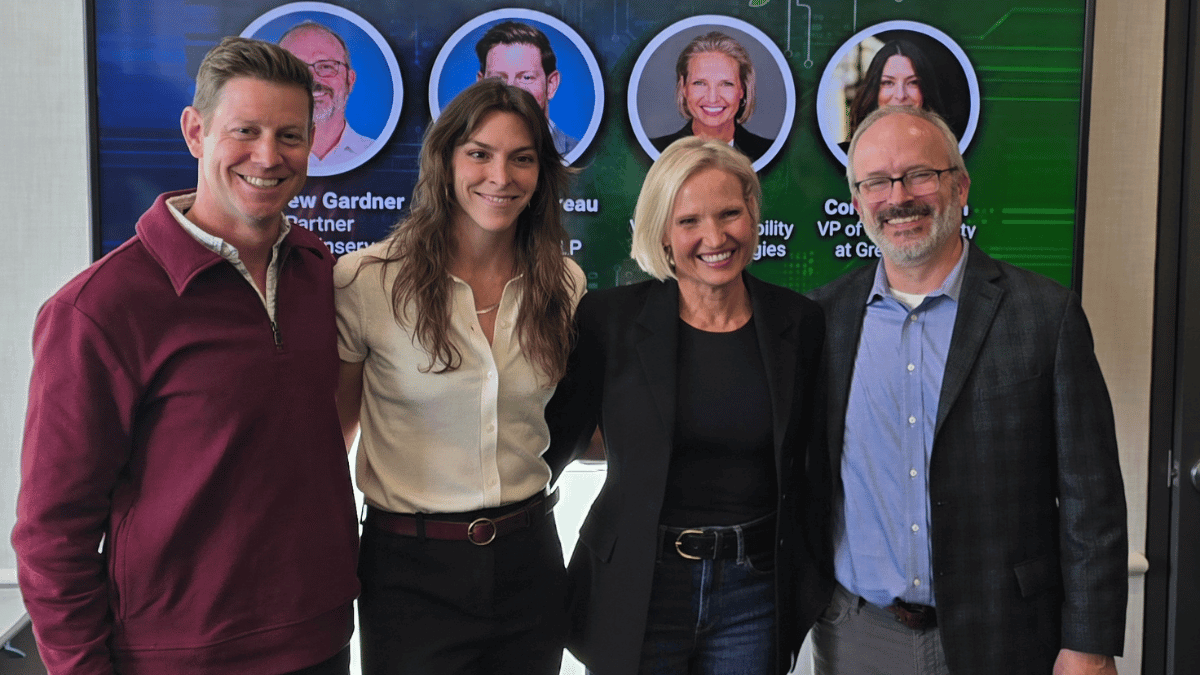
Our session, hosted at the offices of software company Qlik in the Empire State Building, illustrated the rapid maturing of AI across the field of sustainability. The panel was deliberately a cross-section of the sustainability ecosystem: an independent consultancy, Sustainserv, a software company, Qlik, a carbon management platform, Greenplaces, with Sensiba serving as the voice of the auditor in the discussion.
The panelists each shared case studies of how they are leveraging AI in sustainability work:
- Software providers are using AI to speed up greenhouse gas emissions calculations.
- Carbon management platforms are building AI into their models and processes so customers can measure their emissions footprints more efficiently.
- Sustainability consultancies are applying AI to decarbonization pathways (modeling the levers that bend the emissions curve), to nature-adjusted valuation, and to digital twins that bring it all into a living model of the enterprise.
In each part of the sustainability ecosystem, AI is creating efficiencies, automating manual work, and facilitating sophisticated analysis.
Takeaway #2: For Sustainability Assurance, AI Is a Tool but Not an Authority
My role on the panel was to explain what AI means for assurance. That’s where Sensiba’s expertise lies: we verify clients’ greenhouse gas emissions inventories under a variety of standards, including ISO and AICPA standards, reviewing the internal controls and data behind them so they are reliable and disclosure-ready, mostly for companies subject to California’s climate disclosure laws.
Our first core principle is that an auditor cannot take AI at face value. We have to dig into the assumptions and the model so we are comfortable issuing an opinion on AI-generated data. Humans must stay in control at every stage of an engagement.
Within that guardrail, we see AI delivering real value in the most time-intensive aspects of our work:
- Evidence testing. Point AI at a control, let it review the evidence against the relevant criteria, and have a human auditor confirm the result.
- Working across document sets. AI can compare the general ledger with reported emissions data and flag outliers and inconsistencies. A spike in a data set might be a fat-fingered entry, or it might be a site that smelts iron ore. Either way, the human auditor investigates and decides.
- Industry context. We are experts in the standards we audit against, such as ISO 14064-3:2019, but every sector applies the standards differently. AI helps us understand, for example, how a standard plays out in manufacturing versus agriculture.
- Completeness and risk assessment. AI can help test whether an inventory is complete and use historical engagements to show where misstatement risk is likely to be highest for a company of a given size and industry.
Takeaway #3: Companies Need the Right Expertise When It Comes to AI in Sustainability
Three guidelines are emerging for companies around AI in the sustainability space:
1. Know how your platform or consultant is using AI. If parts of your emissions calculations are AI-generated, understand the assumptions behind them and confirm accuracy before the data ever reaches an auditor.
2. Don’t go it alone on carbon accounting. When a client uses AI and/or Excel to calculate their own inventory without a platform or a consultant, the audit generally carries a price premium at Sensiba, because there are typically fewer internal controls and more inconsistencies to resolve. Even with AI, calculating emissions in-house rarely saves money. Experienced consultants and platforms build on the GHG Protocol, the global gold standard, and that foundation pays off.
3. Start with a double materiality assessment. A double materiality assessment identifies the sustainability factors most likely to drive financial risk or opportunity for your particular business. It is one of the best strategy exercises a company can run, and it relies on surveying a wide range of internal and external stakeholders. AI is increasingly useful for aggregating and scoring those responses, taking on the menial work so your team can focus on the findings.
Takeaway #4: The Bigger Picture: Financial Risk and Climate Risk Are Intertwined
Beyond the session, the thread that ran through the week for me is that climate risk and financial risk are intertwined. The less collective action we take to cut emissions, the greater those risks become, and eventually they get priced into the market. Everything becomes more expensive and more volatile. That is why good corporate data governance and assurance matter: people are using this information to make decisions.
With national and global action uncertain, companies are at the center of the response to climate risk. Climate change is not slowing down, and neither are the social inequities that come with it. The companies that keep investing in climate and sustainability leadership will be best positioned for whatever comes next.
Takeaway #5: The Next Generation Is Sustainability-Native
The moments that stayed with me most were human ones. Much of the value of Climate Week, for me, is in the networking events and conversations, and I spoke with many young professionals who are passionate about making business and society better. Sustainability is woven into how Gen Z thinks and into the formal education they received in a way it was not even 10 or 15 years ago. They carry a real sense of urgency, and they are the future of business now.